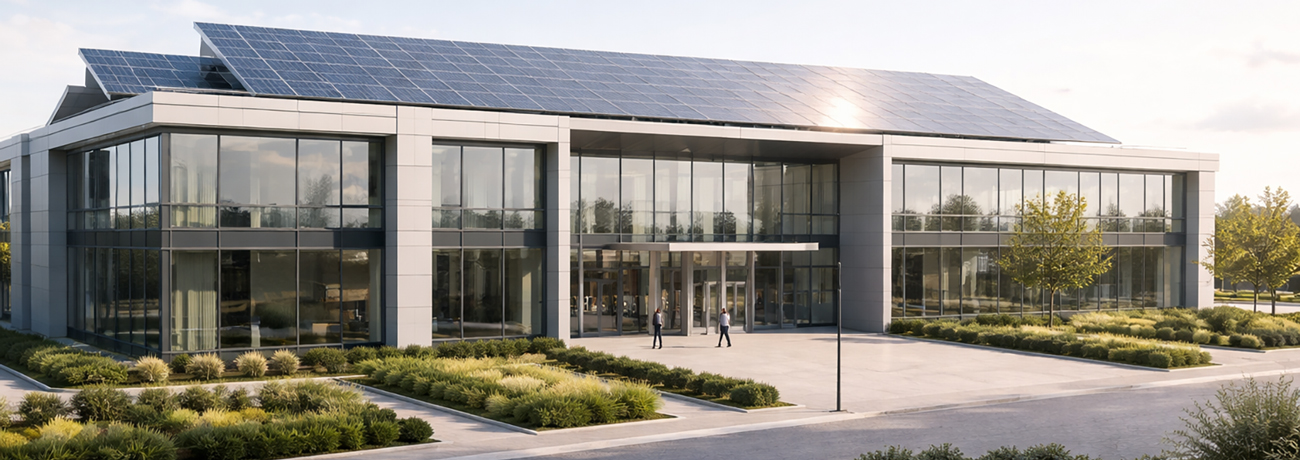
One of the more helpful aspects of solar in the UK is that many installations can proceed without full planning permission. This is because certain types of development fall under what is known as permitted development rights.
For commercial buildings, rooftop solar often sits within those rights, provided the system meets specific conditions. That can make the process more straightforward than people expect.
That said, not every building qualifies, and not every installation fits neatly within those limits.
Permitted development generally allows solar panels to be installed on roofs without submitting a full planning application, as long as certain criteria are met. These typically relate to how far panels project above the roof, how they affect the appearance of the building, and whether they create any safety or structural concerns.
There is also an expectation that installations minimise visual impact where possible. On industrial estates this is rarely an issue. In more sensitive areas, it can become more relevant.
The detail sits in the conditions rather than the headline rule.
Additional consent is normally required due to heritage protection.
Visual impact and positioning are more closely controlled.
Larger installations on land often need formal approval.
There are also cases where roof-mounted systems fall outside permitted development, particularly if they exceed size or positioning limits.
A modern warehouse on an industrial estate is very different from a historic building in a town centre. Planning considerations reflect that difference. Industrial and agricultural buildings tend to have fewer restrictions, while more sensitive locations require greater care.
Multi-tenant office buildings can introduce another layer, particularly where ownership and responsibilities are shared. In those cases, agreements between parties may be needed before planning is even considered.
The context of the building matters as much as the installation itself.
Where planning permission is required, the local authority will assess the proposal against several factors. Visual impact is one of the main ones, particularly in areas where appearance is important. The effect on neighbouring properties, glare and overall design may also be considered.
In most commercial settings, these issues are relatively straightforward. In more sensitive locations, they can carry more weight.
It is rarely about stopping solar altogether. It is about how it is implemented.
If permitted development applies, this stage can be minimal. In some cases, a lawful development certificate may still be sought for confirmation, but this is usually quicker than a full application.
Where planning permission is required, timelines vary depending on the complexity of the proposal and the local authority. Straightforward applications tend to move more quickly than those involving listed buildings or sensitive sites.
It is one of the areas where early checks can save time later.
Ground-mounted systems are more likely to require planning permission, particularly if they cover a large area or alter the use of the land. On farms and larger commercial sites, this can still be feasible, but it usually involves a more formal process.
Access, visual impact and land use are key considerations. These systems can offer flexibility in layout, though they come with different planning requirements compared to rooftop installations.
They are treated more like a development in their own right.
Yes, and quite often. Panel placement, system size and even the type of mounting system can be influenced by planning considerations. In some cases, adjustments are made to keep a project within permitted development limits.
Where planning permission is required, designs may evolve during the application process to address feedback from the local authority.
It is not unusual for the final layout to differ slightly from the initial concept.
Start by understanding the building and its setting. Is it listed? Is it in a conservation area? Does it sit within an industrial estate or a more sensitive location? These factors often determine whether planning permission is needed.
From there, early checks can confirm whether permitted development applies or whether a formal application will be required. This helps avoid delays later in the process.
Planning is not always a barrier, but it is always worth understanding from the outset.