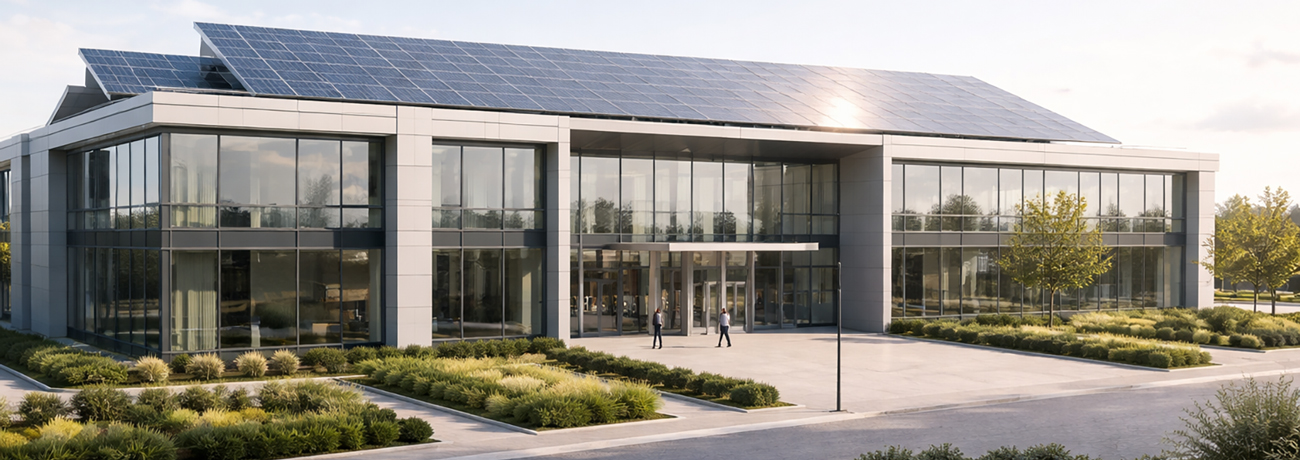
Office buildings appear straightforward compared to industrial sites. No heavy machinery, no large-scale production lines. Yet energy use can still be surprisingly uneven. Heating and cooling systems, lighting, IT infrastructure and occupancy patterns all interact in ways that are not always obvious.
Peak demand often comes from building systems rather than equipment. Air conditioning starting up across multiple floors, heating responding to temperature changes, or ventilation systems running harder during busy periods can all push usage higher.
The result is a building that looks simple but behaves quite differently throughout the day.
Heating, ventilation and air conditioning are usually the main factors. These systems respond to external conditions as well as occupancy, which means demand can change quickly. Lighting also plays a role, though modern LED systems have reduced its impact compared to older setups.
IT equipment is another constant load. Servers, workstations, network equipment and support systems run throughout the day, and often beyond. In larger buildings, lifts, access systems and shared facilities add to the overall demand.
None of these are unusual on their own. It is the combination that shapes the energy profile.
Improving how heating and cooling systems respond can reduce unnecessary demand.
Upgrading and managing lighting reduces base load across the building.
Aligning building systems with actual occupancy avoids wasted energy.
These changes often come before more visible upgrades like solar installations, though they can work alongside them.
Office buildings often align reasonably well with solar generation. Most activity happens during daylight hours, which means electricity produced on-site can be used directly. This is particularly true for lighting, IT systems and base building services.
Roof space can be more limited than on warehouses or factories, especially on multi-storey buildings. That can restrict system size. Even so, smaller systems can still contribute to overall energy use.
It is less about covering the entire demand and more about offsetting part of it consistently.
Storage can help smooth demand, particularly where HVAC systems create short peaks. It can also allow solar energy generated during the day to be used later if the building remains active into the evening.
However, many office buildings have relatively predictable usage patterns. In those cases, storage may not be essential. Its value depends on how much variation exists in the building’s demand profile.
Some buildings benefit from it. Others see more value in control systems and efficiency measures.
Modern office buildings are often designed with energy efficiency in mind, including insulation, glazing and ventilation systems. Older buildings may rely more heavily on mechanical systems to maintain comfort, which can increase energy use.
Layout also matters. Open-plan offices, shared facilities and occupancy patterns influence how systems operate. A building that is only partially occupied can still consume significant energy if systems are not adjusted accordingly.
Design and operation are closely linked in this respect.
Access is usually more restricted than on industrial sites. Working around occupied offices requires careful planning, particularly where internal systems are being upgraded. Noise, disruption and safety all need to be managed.
Roof installations must account for existing plant, access routes and structural limits. Electrical integration can also be more complex where systems serve multiple floors or tenants.
These factors do not prevent upgrades, but they do shape how they are carried out.
Yes, though the approach is often gradual rather than dramatic. Improvements in control systems, efficiency and targeted generation can all contribute. The combined effect can be meaningful over time.
Unlike industrial sites, where large single changes can shift costs quickly, offices tend to benefit from a series of smaller adjustments working together.
That makes understanding the building’s behaviour especially important.
Limited roof space can restrict solar installations. Buildings with highly variable occupancy may find it harder to align systems with usage. In some cases, structural or planning constraints can limit what can be done.
Where these issues arise, focusing on efficiency and control improvements may offer better results than larger installations.
Each building has its own set of constraints to work within.
Start with how the building is actually used. Look at occupancy patterns, system operation and where energy is being consumed throughout the day. That often highlights areas where changes can be made without affecting how the building functions.
From there, consider which solutions match those patterns. Solar, storage and efficiency measures all have a place, but their value depends on how they are applied.
The building’s daily routine tends to provide the clearest direction.