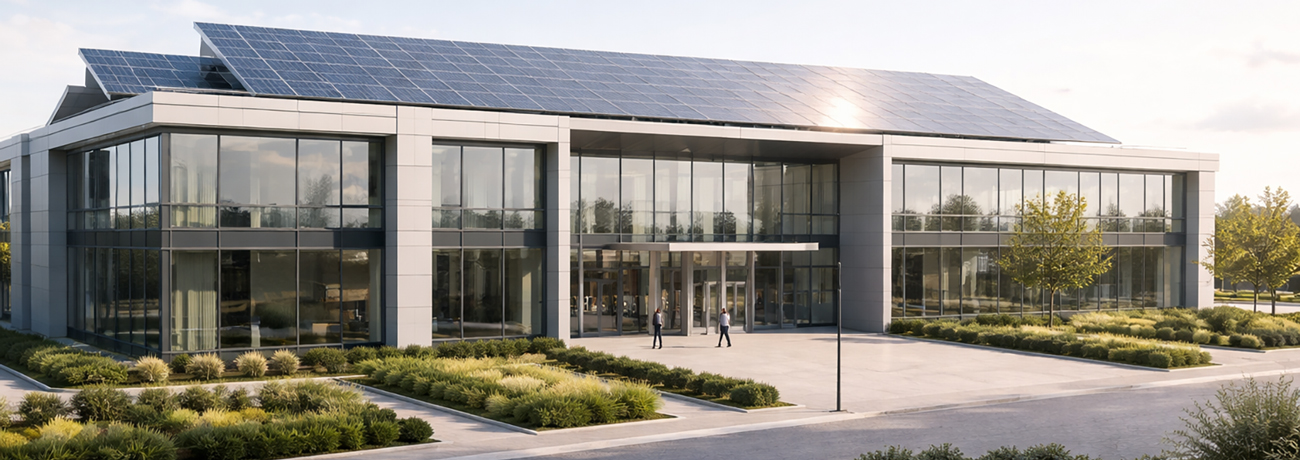
Flat roofs often look like the obvious choice. They usually offer broad open space, fewer awkward angles, and more freedom over how the panels are positioned. On warehouses, factories and larger commercial buildings, that can make a flat roof feel almost purpose-built for solar.
There is some truth in that. Flat roofs can be very good for solar. They allow designers to angle panels in a way that suits the site rather than being locked into the slope of the building. That flexibility is useful. It also means layout, spacing and maintenance routes need more thought than some people assume.
That is the trade-off. Flat roofs can be highly practical, but they are not a case of simply filling every spare bit of roof with panels and hoping for the best.
On a flat roof, panels are usually mounted on a frame that tilts them to the desired angle. That frame may be ballasted, mechanically fixed, or use a combination of both depending on the building and engineering requirements. Ballasted systems rely on weight to hold the frame in place. Mechanically fixed systems attach more directly to the roof structure.
Each approach has implications. Ballast adds weight. Fixings introduce penetrations or attachment details that need to be handled properly. Wind loading matters too, especially on exposed sites or taller buildings. Once you start looking at the practicalities, it becomes clear that roof structure and waterproofing deserve just as much attention as panel performance.
That is why a structural check is never just paperwork. It sits right at the centre of the decision.
Both, depending on the layout. Access is often easier because technicians can move around the roof more naturally than on a steep slope. That is useful for inspections, cleaning and electrical checks. At the same time, flat roofs can become awkward if the solar layout leaves poor access routes or blocks important roof details.
This is where some schemes go wrong. The design focuses heavily on squeezing in extra panels, while maintenance access becomes an afterthought. Then later, a contractor needs to inspect the roof membrane, clear outlets, check plant, or reach other rooftop equipment and finds the route is cramped, inconvenient or risky.
A well-designed system leaves room to work. A crowded one can become a nuisance for years.
Drainage is one of the biggest maintenance issues on flat roofs, solar or no solar. Water does not disappear quickly from a flat surface unless the roof falls, outlets and drainage routes are working properly. Once panels and frames are added, it becomes even more important not to disrupt the movement of water across the roof.
If outlets are hard to reach, if leaves and debris gather more easily, or if water starts ponding around mounting systems, the roof can become harder to maintain and inspect. That may not show up as an immediate problem, but over time it can create headaches. Water has a habit of turning minor neglect into a larger issue.
So any solar design on a flat roof should leave clear access to drainage points and should not create awkward pockets where debris or standing water become more likely.
They can if the system is packed too tightly or if there is no sensible maintenance plan. Flat roofs often need periodic inspection of membranes, seams, drainage details, flashings and rooftop plant. Once solar is installed, those inspections still need to happen.
If the panels are laid out with proper walkways and spacing, inspection is usually manageable. If not, every roof visit becomes more cumbersome. What should be a simple check turns into a careful shuffle around frames and cabling. That is not ideal for roof contractors, solar technicians or anyone paying for the extra time.
It is one of those practical details that rarely makes the sales pitch. It should.
Ballasted systems are common on flat roofs because they can avoid extensive penetrations, but they bring their own considerations. The added weight needs to be suitable for the building. The ballast arrangement must remain stable. The roof beneath still needs inspection, and movement routes must be kept clear.
There is also the matter of how ballast and frames interact with drainage and general housekeeping. If debris builds around the bases or water sits where it should not, the roof can become more awkward to manage. On some buildings, this is not a major problem. On others, especially where maintenance has not always been meticulous, it can be.
Ballast is not a flaw. It just needs treating as part of the whole roof system, not as something separate from it.
Usually not excessively, but it depends on the site. Panels on flat roofs are angled, so rainfall will still help wash them. That said, lower tilt angles, nearby dust, bird activity, industrial fallout or debris from surrounding areas can all affect how clean the panels stay.
Some sites need very little intervention. Others benefit from periodic cleaning to keep output steady. More important than routine cleaning, though, is making sure the system can be accessed safely when cleaning or inspection is needed. If access is awkward, even simple maintenance becomes more expensive.
That is the recurring theme with flat roofs. Not so much whether a task can be done, but whether it can be done sensibly.
They matter a great deal. The roof covering needs to be in suitable condition before solar goes on top. If the membrane is ageing, already patched repeatedly, or nearing the point where major work is likely, it may make more sense to address that first rather than trapping a future roofing job beneath a solar array.
This is particularly important on larger commercial and industrial roofs. Re-roofing or major membrane repairs after solar installation can become more complicated and more expensive because parts of the system may need to be removed and reinstalled. That is a nuisance best avoided if it can be seen coming.
Checking roof condition properly at the start is rarely time wasted.
They need to. Many flat commercial roofs are not empty. They carry HVAC units, vents, access hatches, safety systems, cable trays and other plant that require servicing. A solar layout must work around those realities. Otherwise the roof becomes a tug of war between one maintenance task and another.
Good layouts respect access routes. They allow for maintenance around plant, safe movement for contractors, and sensible separation from areas that need regular attention. Poor layouts can leave technicians muttering under their breath before they have even picked up a tool. Usually a sign something has been arranged badly.
Solar should fit around the building’s ongoing needs, not make routine maintenance more irritating than it already is.
Not always. Flat roofs are flexible, which is useful, but they also demand careful design around ballast, drainage, spacing and access. Pitched roofs can sometimes be simpler if the orientation is decent and the structure suits the load. The right answer depends on the building rather than on a rule of thumb.
Flat roofs do have a strong advantage on larger commercial sites because of usable area and layout control. Still, that advantage counts for more when the roof condition is sound and maintenance planning is taken seriously from the start.
Otherwise a supposedly straightforward solar project can grow extra complications for the roofing and facilities teams later on.
They make the most sense when the building has a sound roof, good usable area, sensible drainage, clear access routes and a daytime electricity demand that suits on-site generation. Add a layout that respects future inspection and maintenance, and the case becomes much stronger.
That is usually the sweet spot. A site with a decent load profile, a roof in good order, and enough room to install panels without turning the roof into an obstacle course. Warehouses and industrial buildings often fall into this category, though not always. The detail still matters.
It usually does, in fact. Roofs have a habit of punishing lazy assumptions.
Start with roof condition and structure. Then look at drainage, access, rooftop plant and how the building uses electricity through the day. Those points tell you far more than broad claims about roof area alone.
After that, the design should show clearly how maintenance will work in practice. Can outlets be reached? Can the membrane be inspected? Can plant still be serviced without contortions? If those answers are vague, the scheme needs more thought.
Flat roofs can be excellent for solar. They just reward careful planning and punish crowded layouts. A familiar pattern, really.